

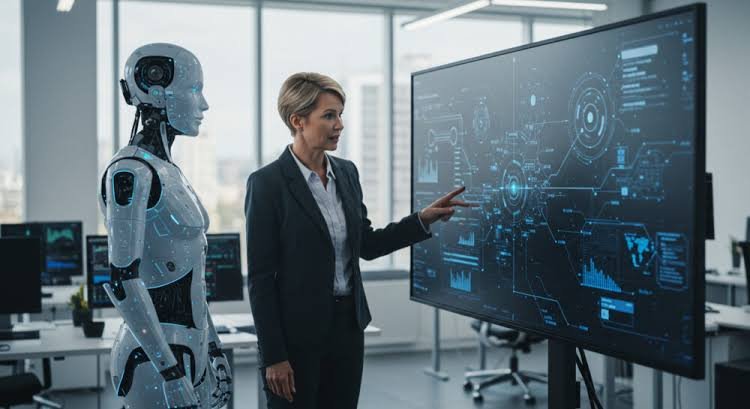
For Indian manufacturers, the next phase of AI adoption will depend less on chasing the latest technology and more on getting the fundamentals right — clean data, disciplined processes, trained people and clear accountability.
Artificial Intelligence is moving rapidly from experimentation into the enterprise.
Manufacturers are exploring AI for predictive maintenance, asset management, shop-floor operations, quality control and process automation. At the same time, technologies such as digital twins and agentic AI are beginning to change how industrial organisations think about automation.
But there is a problem.
Technology can move much faster than the organisation adopting it.
For manufacturers operating factories, infrastructure assets and complex supply chains, an AI implementation cannot simply be switched on and left to operate. The underlying business processes need to be ready, the data needs to be reliable and employees need to understand how the technology fits into their work.
This is the central message from Rajkumar Ayyella, CIO, RPG Group (KEC International Limited), who brings more than two decades of experience across global industrial and technology environments. In a conversation for Express Computer’s Future Factory series, Ayyella argues that organisations should resist the pressure to adopt technology simply because everyone else is doing it.
The Core Business Must Come First
Ayyella’s approach begins somewhere that may seem surprising in an AI conversation:
the business itself.
Technology transformation cannot operate independently from the core business.
Manufacturing environments are particularly sensitive to disruption. Factories may have decades of investment embedded in equipment, processes and operational technology. Introducing a new technology without understanding these dependencies can create more problems than it solves.
This makes the relationship between IT and OT — information technology and operational technology — increasingly important.
As digital systems move deeper into manufacturing environments, cybersecurity, scalability and integration between IT and OT need to become board-level considerations.
The objective is not to replace existing infrastructure simply because newer technology exists.
It is to make existing operations better without putting business continuity at risk.
Digital Twins Can Create a Safe Environment for Innovation
One technology that Ayyella sees as particularly valuable for manufacturing is the digital twin.
A digital twin can essentially provide a digital representation of a physical system or process.
For manufacturers, this creates an opportunity to experiment before making changes to a live environment.
Teams can simulate processes, test potential changes, train employees and evaluate outcomes without immediately exposing the physical operation to risk.
This becomes particularly valuable in industries where downtime can have significant financial and operational consequences.
Instead of asking organisations to experiment directly on the production environment, digital twins provide something closer to a rehearsal space for industrial innovation.
That could allow manufacturers to move faster while reducing the risks associated with transformation.
The Biggest AI Problem May Not Be AI
One of Ayyella’s strongest observations is that organisations should not allow FOMO — fear of missing out — to drive technology decisions.
There is currently enormous pressure on enterprises to demonstrate AI adoption.
Every organisation wants an AI strategy.
Every CIO is being asked about agentic AI.
Every technology vendor is presenting new use cases.
But the presence of an AI project does not automatically create business value.
According to Ayyella, three fundamentals need to work together:
People. Processes. Data.
If employees are not trained, processes are poorly defined and data is unreliable, introducing a sophisticated AI model will not solve the underlying problem.
It may simply automate the existing inefficiency.
That makes data quality and process discipline among the most important prerequisites for enterprise AI.
Treat AI Agents Like Junior Colleagues
This is perhaps the most interesting part of Ayyella’s philosophy.
Instead of treating an AI agent as a software feature that can immediately be deployed, organisations should think of it as something closer to a junior colleague.
A junior employee does not join an organisation and immediately understand every process.
They need:
- Training
- Context
- Clear responsibilities
- Defined processes
- Supervision
- Feedback
- Time to develop reliability
A similar approach should be applied to AI agents.
An agent needs to understand the processes within which it operates. It needs reliable information. Its responsibilities need to be clearly defined.
And importantly, humans need to remain responsible for supervising its output.
The quality of an AI agent therefore depends heavily on the quality of the organisation around it.
If the organisation provides poor data and poorly defined processes, the agent cannot magically compensate for them.
AI Will Change Jobs — But Humans Will Retain Accountability
The impact of AI on employment is another area where Ayyella expects significant change.
He does not view the future simply as a story of machines replacing humans.
Instead, he expects existing roles to change and new roles to emerge.
Some repetitive activities will increasingly be performed by machines.
Other roles will evolve around managing, supervising and working alongside AI systems.
But one responsibility is unlikely to disappear:
accountability.
Machines can process enormous volumes of information without fatigue or emotion.
Humans, however, remain responsible for understanding the broader context surrounding a decision.
This distinction could become increasingly important as AI agents begin participating in enterprise decision-making.
Context May Become the Most Valuable Human Skill
The future technology professional may therefore need a different set of skills.
Knowing a programming language or understanding a particular AI model will remain valuable, but Ayyella places particular importance on context.
AI can analyse information and identify patterns.
But understanding why a particular decision matters requires knowledge of the business, customers, employees, risks and broader circumstances.
Human experience becomes especially important when decisions involve factors that cannot easily be represented in structured data.
This suggests that the future workplace may not be a competition between humans and AI.
It may be a collaboration where machines handle increasingly complex information processing while humans provide judgement, context and accountability.
Three Fundamentals CIOs Cannot Ignore
Ayyella’s approach can be distilled into three major priorities.
1. Understand the Core Business
Technology initiatives need to be connected to measurable business outcomes.
Organisations should first understand the problem they are attempting to solve before selecting a technology.
2. Redesign the Process
AI cannot automatically repair a broken business process.
Processes need to be examined, simplified and redesigned before automation is introduced.
3. Build Trust in Data
AI is only as reliable as the information and processes supporting it.
Clean, governed and trusted data therefore becomes one of the most important foundations for enterprise AI.
These principles are particularly important for manufacturing because technology operates alongside physical assets, people and production processes.
The Manufacturing AI Stack Is Becoming More Complex
The next generation of industrial transformation will not be driven by one technology.
Instead, manufacturers will increasingly combine:
IoT + Data + Cloud + AI + Digital Twins + Automation + Cybersecurity
These technologies will need to operate together.
That makes architecture and integration increasingly important.
A manufacturer may have sophisticated AI models, but if its data is fragmented or its operational systems cannot communicate effectively, the value of those models will remain limited.
This is why the convergence of IT and OT is becoming so important.
AI Governance Will Become a Boardroom Issue
AI is also likely to follow a path similar to cybersecurity.
Cybersecurity was once largely viewed as a technical IT responsibility.
Today, major cyber risks can directly affect business continuity, reputation, financial performance and regulatory compliance.
AI could follow a similar trajectory.
As AI agents gain more autonomy and begin interacting with enterprise systems, questions about governance, accountability and risk will increasingly reach the boardroom.
Organisations will need to determine:
- What can an AI agent do independently?
- When must a human approve a decision?
- What data can an agent access?
- Who is accountable when an AI-driven action goes wrong?
- How can AI decisions be audited?
- How should AI systems be trained and monitored?
These are not merely technical questions.
They are business governance questions.
The Factory of the Future Will Still Need People
The phrase “factory of the future” can sometimes create an image of completely autonomous facilities where machines perform almost everything.
The reality is likely to be more nuanced.
AI and automation will increasingly handle repetitive, data-intensive and predictable activities.
Humans will increasingly focus on:
judgement, creativity, context, leadership and accountability.
The winning manufacturing organisations will therefore not necessarily be those that automate the most.
They will be those that understand where automation creates value and where human judgement remains essential.
The Real AI Advantage Is Operational Discipline
The most important lesson from Ayyella’s perspective is ultimately not about a particular AI model or platform.
It is about organisational discipline.
Companies that want to deploy AI at scale need to first understand their operations.
They need clean data.
They need well-defined processes.
They need trained employees.
They need governance.
And they need a clear understanding of what success looks like.
Only then can AI become a genuine transformation tool rather than another technology experiment.
Conclusion
India’s manufacturing sector is entering an important phase of digital transformation.
AI, digital twins and agentic automation have the potential to reshape factories, supply chains and industrial operations.
But technology alone will not create that transformation.
The organisations that benefit most will be those that build the right foundation before scaling AI.
That means putting business fundamentals before technology hype.
It means treating AI agents as systems that need to be trained and supervised rather than simply switched on.
And it means recognising that while machines may increasingly perform tasks, humans will continue to provide the context and accountability that make those decisions meaningful.
The future factory may be powered by AI.
But it will still be designed, governed and ultimately accountable to people.
