

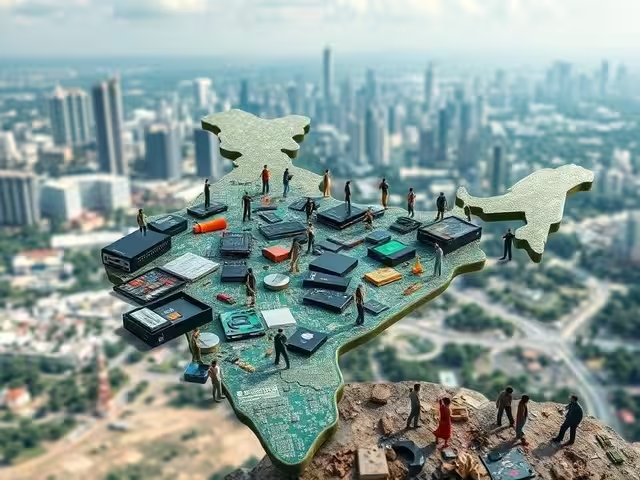
As AI workloads drive unprecedented demand for data capacity, India’s engineering talent is playing an increasingly important role in developing the storage technologies required to support the next generation of enterprise infrastructure.
Artificial Intelligence is changing the infrastructure equation.
Every new AI application creates more data. Training datasets need to be stored. Models need to be retained. Inference generates additional information. Enterprises need to preserve increasingly large volumes of business data.
The result is a storage challenge that is often less visible than the race for GPUs but equally important.
AI needs somewhere to store everything it creates.
Hard disk drives continue to play an important role in this environment because enterprises and hyperscalers need enormous amounts of cost-efficient, high-capacity storage.
At the centre of this transformation is also a changing role for India.
Western Digital’s India engineering ecosystem has become one of the company’s major global engineering centres, contributing to hardware, firmware, architecture, testing and validation for next-generation storage platforms.
In an exclusive conversation with Express Computer, Kaustubh S. Patkar, Country Head & Senior Director, Western Digital India & HDD Engineering, discussed how the company’s Indian engineering teams are contributing to global storage innovation and responding to the growing demands created by AI and data-intensive workloads.
India’s Role Is Moving Beyond Talent
India has long been recognised as a major technology talent hub.
But the nature of that contribution is changing.
Indian engineering teams are increasingly participating in product architecture, research, development, testing and intellectual-property creation rather than simply supporting global operations.
According to Patkar, Western Digital’s India teams recently contributed to 36 invention disclosures, highlighting the role of the country’s engineering organisation within the company’s global IP pipeline.
This shift is significant.
It suggests that India’s technology ecosystem is becoming increasingly involved in creating the underlying technologies that power global products.
Storage Has Become an AI Infrastructure Problem
AI discussions often focus on GPUs, networking and compute.
Storage is sometimes treated as a secondary component.
But the rapid growth of AI workloads is changing that equation.
AI systems require enormous datasets.
Those datasets need to be stored, accessed, processed and retained.
Enterprises also need storage for:
- Training datasets
- AI models
- Inference data
- Business applications
- Backups
- Archives
- Compliance records
- Analytics workloads
As the volume of data increases, organisations need storage systems that can deliver capacity without making infrastructure costs unsustainable.
This is where HDD technology remains strategically relevant.
The HDD Is Still Evolving
It would be easy to assume that HDD technology is mature and therefore no longer changing significantly.
That would be a mistake.
Manufacturers continue to innovate across magnetic recording, firmware, mechanics, caching, controllers and drive architecture.
Western Digital’s current technology portfolio includes innovations such as energy-assisted PMR, UltraSMR and HelioSeal, while the company is also sampling HAMR drives with hyperscale partners to push storage density further.
The objective is straightforward:
More capacity, better efficiency and lower total cost of ownership.
HAMR Could Push Capacity Further
Heat-Assisted Magnetic Recording, or HAMR, represents one of the technologies being explored to increase HDD storage density.
The technology uses heat to enable data to be written onto media at increasingly high densities.
For hyperscale operators and large enterprises, increased density can have an important infrastructure impact.
More capacity per drive can potentially mean:
- Fewer drives for a given capacity requirement
- More efficient use of data-centre space
- Reduced infrastructure overhead
- Better storage economics
Western Digital has begun sampling HAMR drives with selected hyperscale partners, according to Patkar.
Firmware Is Becoming More Intelligent
Storage innovation is not only about physical hardware.
Firmware is becoming an increasingly important part of storage intelligence.
Modern enterprise drives need to manage complex workloads while maintaining reliability and performance.
Western Digital’s India engineering teams are working on areas including:
- Firmware algorithms
- Controller architectures
- Smarter caching
- Data-management frameworks
- Storage solutions designed for AI workloads
These software-driven improvements can help organisations extract more value from the hardware they already deploy.
This is particularly important as workloads become more dynamic.
AI Is Also Changing How Storage Is Designed
One of the most interesting aspects of the interview is that AI is not simply another workload for Western Digital.
The company is also using AI during the development of storage technology itself.
Patkar describes AI as an active collaborator across the product-development lifecycle — from architecture through to in-field performance insights.
This creates a feedback loop.
AI generates more data.
More data creates greater demand for storage.
AI can then also help engineers analyse information and improve the design of the storage systems supporting those workloads.
AI Does Not Replace Engineers
The role of AI within engineering is not necessarily about replacing human expertise.
Instead, it can remove repetitive activities and accelerate analysis.
Western Digital is using proprietary datasets and domain-specific AI models to help engineers reduce repetitive tasks and speed up decision-making.
This leaves engineers with more time to focus on:
Architecture + Innovation + Problem Solving + Product Design
The broader lesson extends beyond storage.
Enterprise AI adoption may create its greatest value when it augments specialised expertise rather than simply automating jobs.
India as an Innovation Centre
Western Digital’s Bengaluru Engineering & Development centre is integrated into the company’s global R&D network.
The company says its global ecosystem includes seven R&D hubs, more than 300 PhDs and a portfolio of approximately 4,500 patents.
This illustrates the scale of the research environment in which the India team operates.
The Indian engineering centre is not working in isolation.
It is connected to global technology roadmaps, customers and other research teams.
That integration is becoming increasingly important as storage technology becomes more specialised.
Building an Innovation Culture
Technology innovation ultimately depends on people.
Western Digital has introduced initiatives designed to encourage engineers to develop ideas and convert them into intellectual property.
One example is the She Invents India Women Inventor Mentorship Programme, which provides mentorship to women technologists working towards patent filings.
According to the interview, the number of women inventors in Western Digital’s patent programme increased by 88% between FY2020 and FY2024.
The significance extends beyond the programme itself.
A strong innovation ecosystem requires mechanisms that help employees move from:
Idea → Research → Prototype → Patent → Product
The Enterprise Storage Equation Is Changing
Enterprise customers increasingly want more than raw capacity.
They need storage that delivers a combination of:
- High capacity
- Reliability
- Energy efficiency
- Performance
- Scalability
- Manageability
- Low total cost of ownership
AI intensifies these requirements.
The storage infrastructure supporting an AI environment needs to scale alongside the growth of data.
This makes storage architecture a strategic infrastructure decision rather than simply a procurement exercise.
Storage and Sustainability
The growth of data also creates an energy challenge.
Data centres consume significant amounts of electricity, and storage infrastructure contributes to that footprint.
Improving capacity density and efficiency can therefore have sustainability benefits.
If more data can be stored within a smaller physical infrastructure footprint, organisations may potentially reduce some of the associated power, cooling and space requirements.
This makes storage efficiency relevant not only to IT budgets but also to sustainability strategies.
The Future of Enterprise Storage
The long-term storage roadmap is being shaped by several simultaneous forces:
AI + Hyperscale + Data Growth + Cloud + Enterprise Applications
Each is increasing the demand for reliable storage.
At the same time, enterprises are looking for technologies that can reduce their total cost of ownership.
This creates an environment where HDDs continue to have an important role even as flash storage and other technologies advance.
The future is unlikely to be about one storage technology replacing everything else.
Instead, enterprises will continue to use different storage technologies for different workloads.
Why India’s Engineering Ecosystem Matters
India’s contribution to this transformation is larger than simply supplying engineers.
The country’s engineering ecosystem is increasingly becoming part of global product innovation.
That matters because deep-tech development requires:
- Specialised engineering knowledge
- Research capabilities
- Intellectual property
- Cross-functional collaboration
- Product-development experience
- Global customer understanding
India has increasingly developed these capabilities.
Western Digital’s India engineering operations provide another example of this evolution.
The Bigger AI Infrastructure Picture
There is a tendency to describe the AI infrastructure race primarily in terms of GPUs.
But the AI stack is much larger.
A production AI environment requires:
Compute → Networking → Storage → Data → Security → Software
A weakness in any one layer can affect the entire system.
Storage therefore deserves greater attention as organisations plan their AI infrastructure.
The ability to store massive datasets efficiently could become just as important as the ability to process them.
Conclusion
The AI era is creating an unprecedented demand for data infrastructure.
While GPUs and AI models receive much of the attention, storage remains one of the foundational layers supporting the entire ecosystem.
Western Digital’s India engineering organisation demonstrates how India’s technology ecosystem is increasingly contributing to this infrastructure at a global level.
From firmware and controller architecture to high-capacity HDD technology, AI workload optimisation and next-generation recording technologies, Indian engineers are participating in the development of storage platforms designed for an increasingly data-intensive world.
The bigger story is not simply about HDDs.
It is about India’s transition from a technology delivery centre into a global engineering and innovation engine.
As AI continues to generate extraordinary volumes of data, the companies capable of storing that data efficiently, reliably and sustainably will become increasingly important.
And the next chapter of the AI revolution may ultimately depend on something far less glamorous than the AI model itself:
where all that data lives.
