

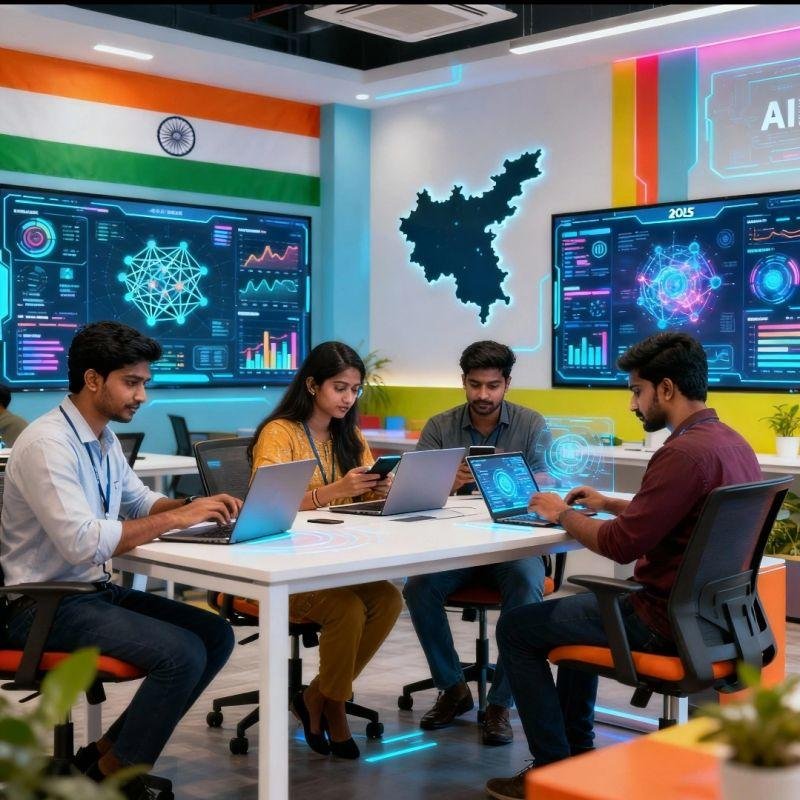
India is in the middle of one of the world’s most significant digital transformations.
From Aadhaar and UPI to the broader India Stack and a rapidly expanding technology ecosystem, digital infrastructure has become an important foundation of India’s economy. At the same time, the country has one of the world’s largest young populations — a generation that has grown up with smartphones, social media, digital services and rapidly evolving technologies.
Yet these two advantages are not being connected as systematically as they could be.
India has the digital infrastructure and the digital-native workforce. The next challenge is putting young professionals at the centre of the transformation taking place across businesses and industries.
The Digital Divide Is Changing
The digital divide is often described as a question of access: who has an internet connection, a smartphone or access to digital services.
That remains important.
But businesses are facing another divide — the gap between organisations that are digitally capable and those struggling to adapt.
For many organisations, the biggest barrier is no longer simply access to technology. It is people who know how to use technology strategically.
Companies need professionals who understand artificial intelligence, data analytics, digital platforms, social media, automation and emerging technologies.
These are rapidly becoming baseline capabilities rather than specialist advantages.
Young Indians are uniquely positioned to contribute.
They have grown up navigating digital platforms, learning through online communities and adapting quickly to new technologies. For many, technologies that may require experienced professionals to learn from scratch are already part of everyday life.
The problem is that organisations do not always use this capability strategically.
From Digital Users to Digital Leaders
Young professionals are often recruited into entry-level positions and given routine responsibilities.
There is nothing inherently wrong with that.
But organisations can lose significant value when digital-native employees are treated only as junior resources rather than potential drivers of transformation.
A young data analyst may understand emerging consumer behaviour.
A young developer may identify opportunities for automation.
A young social-media professional may understand digital communities that traditional marketing teams struggle to reach.
A young technology professional may identify a better way of delivering a customer experience.
The opportunity is to give these professionals responsibility, authority and access to decision-makers.
Building Youth-Led Digital Transformation Teams
Organisations could establish dedicated digital transformation teams with meaningful representation from young technology professionals.
These teams should not operate as isolated innovation units that produce recommendations nobody implements.
They should have a direct connection to senior leadership and the authority to propose, test and implement digital improvements.
Their responsibilities could include:
- Identifying opportunities for AI adoption
- Improving customer-facing digital platforms
- Analysing business data
- Automating repetitive processes
- Developing digital products
- Improving social-media engagement
- Identifying emerging technologies
- Evaluating cybersecurity and technology risks
The objective should be simple: turn digital capability into measurable business outcomes.
Creating Technology Fellowships
Not every organisation has the resources to build an advanced digital team internally.
This is particularly relevant for smaller businesses, regional organisations and public-sector institutions.
One potential solution is a technology fellowship model in which young professionals are placed within organisations that need digital expertise.
A young data scientist, for example, could work with a tourism board to analyse visitor behaviour and improve destination marketing.
Similarly, a technology fellow could help a manufacturing company assess opportunities for IoT, predictive maintenance or supply-chain analytics.
This creates value on both sides.
Organisations gain access to emerging technology expertise, while young professionals gain exposure to real operational challenges.
Reverse Mentoring for the Digital Age
Traditional mentoring usually moves in one direction: experienced professionals teach younger employees.
Digital transformation requires a more balanced model.
Reverse mentoring allows younger professionals to educate senior leaders about emerging technologies, digital behaviour and changing customer expectations.
A senior executive may understand the company’s history, financial position and strategic priorities better than anyone else.
But a younger professional may have a much closer understanding of how Gen Z consumers discover brands, use social platforms or interact with AI tools.
Combining these perspectives can produce better decisions.
The goal is not to make youth the authority on everything.
It is to make sure organisations do not make technology decisions without listening to the people closest to emerging digital behaviour.
Digital Transformation Across Industries
The opportunity extends well beyond technology companies.
Manufacturing
Young professionals can support Industry 4.0 initiatives involving IoT sensors, predictive maintenance, automation and supply-chain analytics.
Hospitality
Hotels and travel companies can use young digital talent to develop AI-powered concierge services, personalised recommendations and stronger digital engagement with guests.
Financial Services
Young professionals can contribute to digital banking platforms, financial inclusion initiatives and fraud-detection systems.
Tourism
Technology can help destinations understand visitor behaviour, improve marketing and create personalised experiences for travellers.
Across these industries, young professionals can act as a bridge between emerging technology and practical business applications.
Incentives Instead of Mandates
The objective should not necessarily be to impose rigid requirements on every organisation.
A more flexible approach could combine incentives with light-touch expectations.
Government and industry bodies could consider incentives for organisations that create meaningful youth participation in digital roles, while digital transformation programmes could include youth development components.
Technology grants, fellowships, innovation programmes and industry partnerships could all contribute to this ecosystem.
The emphasis should remain on outcomes rather than simply meeting representation targets.
India’s Digital Transformation Needs Its Digital Generation
Digital transformation is ultimately about more than adopting new technology.
It is about changing how organisations operate, how they serve customers and how they compete.
An organisation can purchase AI software, deploy cloud infrastructure or install IoT sensors — but without people capable of understanding and applying those technologies, transformation remains incomplete.
India’s young workforce represents one of its greatest strategic assets in this transition.
The country has the infrastructure.
It has the technology ecosystem.
And it has millions of young people who are comfortable navigating the digital world.
The opportunity now is to connect these three forces.
India’s digital transformation should not simply happen to its young generation. Its young generation should help lead it.
