

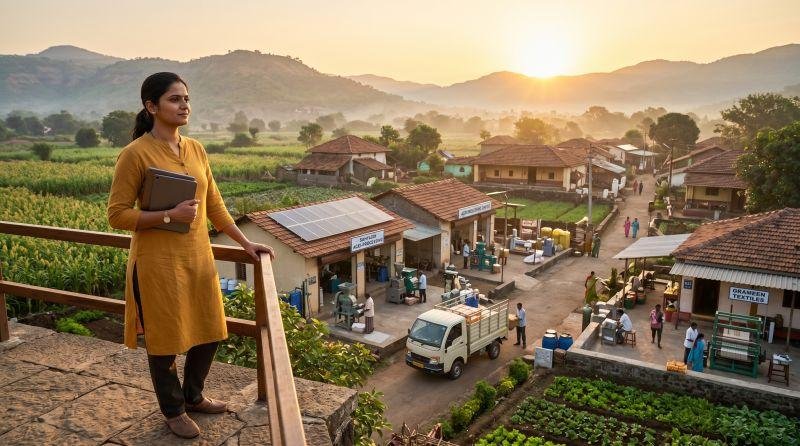
Decentralizing Opportunity: Connecting Youth to India’s Hinterland
For decades, India’s development has concentrated in its metropolitan areas, and young people from rural areas and smaller cities have often felt compelled to migrate to urban centers in search of opportunity. That migration, while sometimes beneficial to the individual, has also created real problems: overcrowded cities, neglected rural areas, and a growing disconnect between talent and place.
This pillar aims to reverse that pattern by integrating youth into tourism, handicrafts, agriculture, manufacturing, and service-sector projects in smaller cities and rural areas.
The Regional Challenge
India’s regional disparities are stark. A small number of cities account for a disproportionate share of economic activity, jobs, and investment, and the result is a vicious cycle: urban areas attract talent and investment and grow faster, while rural areas lose their best people and fall further behind.
This pattern isn’t sustainable. It creates social tension, infrastructure bottlenecks, and missed economic opportunity, and it wastes real human capital — young people from small towns have skills, intelligence, and ambition, but too often the only visible path to success is leaving home.
The Tourism Opportunity
Tourism is particularly well suited to regional development. India’s cultural, geographical, and culinary diversity is its greatest asset, yet most tourism activity still concentrates around a handful of famous destinations, leaving the potential of lesser-known ones largely untapped.
Young people, who understand local culture, speak local languages, and have the digital skills to market destinations to global audiences, can be the architects of regional tourism development — developing homestays that offer authentic accommodation in rural and semi-urban areas, curating cultural, adventure, wellness, and culinary experiences that connect travelers with local communities, connecting artisans with markets through e-commerce and direct marketing, and digitizing and promoting local heritage for visitors.
Beyond Tourism
Tourism isn’t the only sector where regional development can accelerate. In agriculture, young people can build market linkages, introduce sustainable practices, and develop value-added processing — agriculture isn’t just a source of food, it’s a source of livelihoods, and youth-led innovation can transform it.
In handicrafts, young designers can bridge traditional skills and contemporary markets, creating products that preserve cultural heritage while appealing to modern consumers. In manufacturing, small-scale production in rural areas can create employment, reduce dependence on large urban factories, and build resilience into supply chains. And in services, remote work and digital platforms let young people in rural areas work for companies anywhere, bringing outside income into local communities.
The Policy Framework
Several policy levers can accelerate regional youth engagement: investment incentives — tax breaks, subsidized infrastructure, priority in government procurement — for businesses that locate in smaller cities and rural areas and hire young people; skill development training offered locally, so young people don’t have to relocate to access it; broadband and mobile connectivity extended to all areas; incubation centers and entrepreneurship support available regionally, not just in metropolitan hubs; and improved roads, rail, and air connectivity that make smaller cities accessible to markets.
The Business Case
For businesses, regional engagement offers genuine upside: smaller cities and rural areas represent growing consumer markets, and early movers gain a real advantage; regional suppliers offer variety and often lower costs, building resilience into supply chains; and young people in smaller cities are often highly motivated, less mobile, and more loyal — a strong source of talent for businesses with regional operations.
The Broader Vision
Ultimately, regional development is about more than economics — it’s about building a society where every place matters and every young person has a real chance to thrive without leaving their community behind, rather than a country divided into successful cities and neglected hinterlands.
