

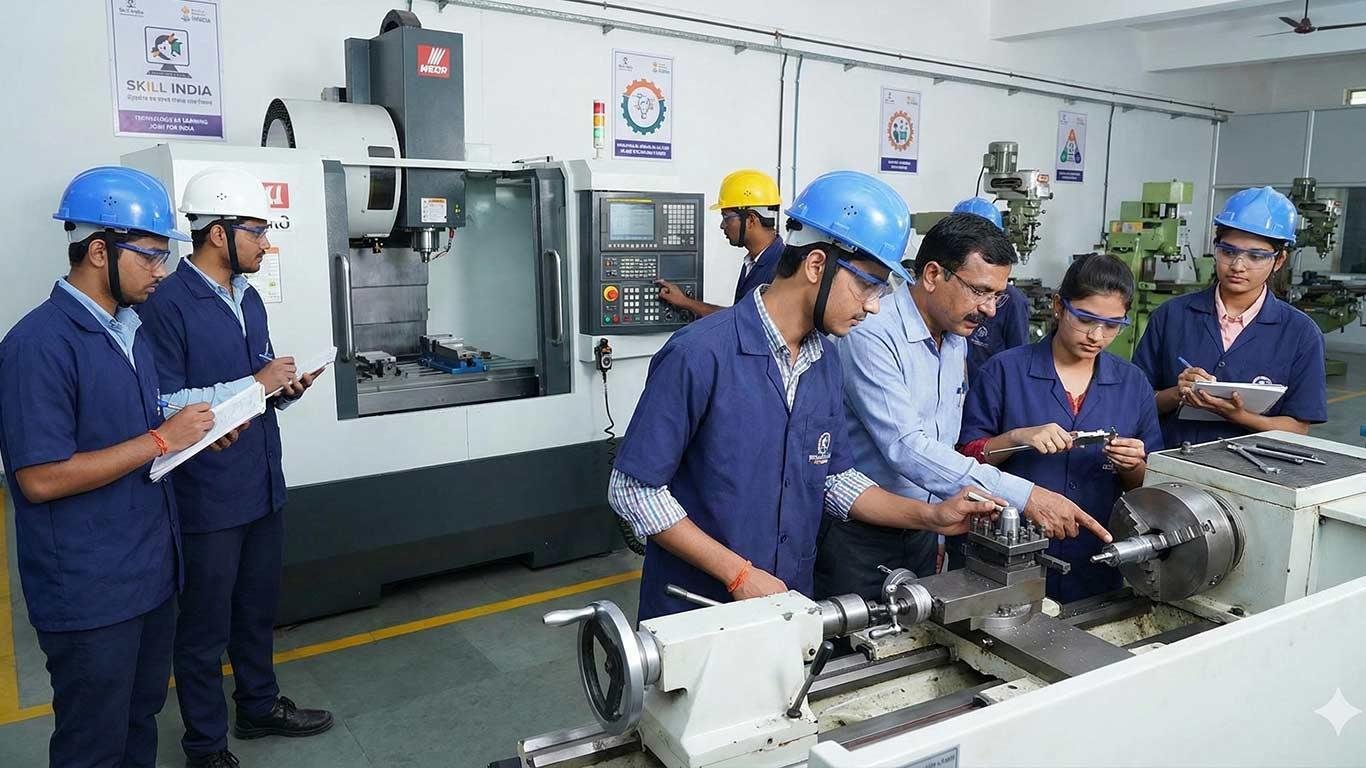
The gap between formal education and workplace readiness has become one of India’s most persistent challenges. Every year, millions of graduates emerge from universities and vocational institutions armed with theoretical knowledge but lacking the practical competencies that employers actually require. This is not a failure of students; it is a systemic failure of the education-industry interface.
The first pillar of a robust youth participation framework addresses this head-on: structured, mandatory exposure to real workplaces, projects, and industry practices for every eligible young person.
The Current Reality
Consider the statistics. India’s employability rate among graduates hovers around 50 percent, meaning that half of all degree-holders lack the skills needed for even entry-level positions. In sectors like hospitality, manufacturing, and technology, the gap is even wider. Employers spend significant resources on retraining fresh hires—resources that could be better deployed on innovation and growth.
Traditional internships, while valuable, are often ad hoc and uneven. Some students receive meaningful mentorship; others are relegated to photocopying and coffee runs. There is no standardization, no quality assurance, and no guarantee that the internship actually builds employability.
A New Framework
The solution is a mandatory industry training program integrated into every educational pathway. This is not merely an internship; it is a structured curriculum delivered in partnership with industry.
Imagine the following architecture:
- Duration: Every student completing secondary education or its equivalent undertakes a minimum of six months of structured industry exposure.
- Structure: Training is divided into modules—foundational (safety, ethics, communication), technical (domain-specific skills), and project-based (real problem-solving).
- Assessment: Performance is evaluated not by academic criteria but by industry benchmarks, with certification that carries weight in the job market.
- Diversity: Training spans multiple sectors, exposing students to manufacturing, services, technology, and creative industries, allowing informed career choices.
- Incentives: Organizations providing training receive tax benefits, regulatory ease, and recognition, creating a virtuous cycle of participation.
The B2B Opportunity
For industry, this framework is not a compliance burden; it is a talent pipeline strategy. Organizations that invest in training programs gain first access to the best-prepared graduates. They shape the curriculum to reflect actual business needs. They reduce recruitment costs and improve retention.
Consider a hotel chain that trains 500 students annually through a structured program. These students emerge with operational fluency in front office, housekeeping, F&B, and revenue management. They understand the brand standards, the technology stack, and the service philosophy. When they are hired, they contribute from day one—no lengthy ramp-up required.
Beyond the Bottom Line
There is a deeper purpose here. Practical industry training builds character, work ethic, and professional confidence. A young person who has solved real problems in a real workplace is more resilient, more adaptable, and more self-assured. They understand the dignity of labor, the value of collaboration, and the satisfaction of contribution.
For a nation seeking to build a skilled, productive, and innovative workforce, this pillar is foundational. It addresses the employability gap at its root. It transforms education from a theoretical exercise into a preparation for life. And it ensures that India’s demographic dividend becomes an economic reality rather than a statistical mirage.
