

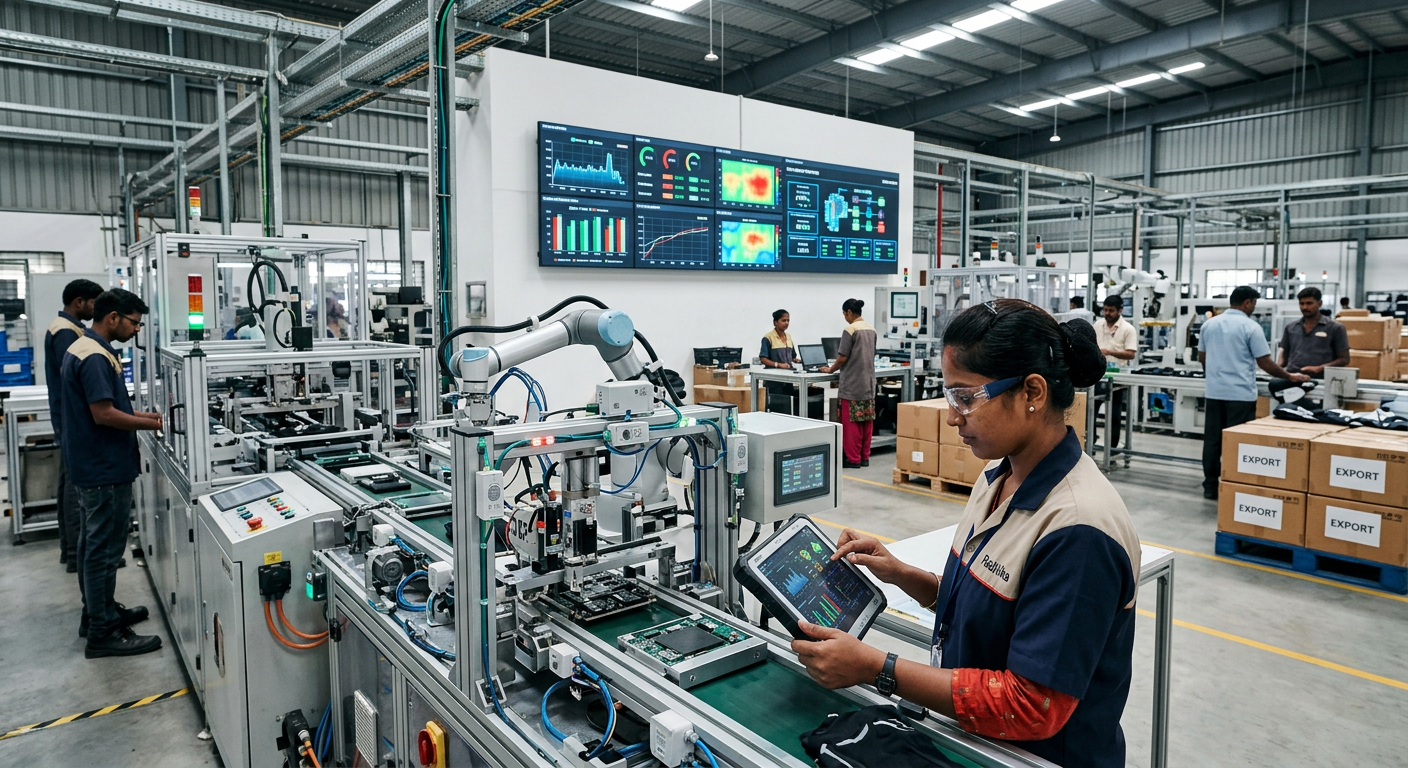
How Smart Manufacturing and IoT Are Transforming India’s Manufacturing Exports
As international buyers demand greater supply-chain visibility and consistent quality, connected factories are redefining how Indian companies produce and deliver goods for global markets.
India’s manufacturing sector is undergoing a major technology-led transformation, with smart manufacturing and the Internet of Things (IoT) increasingly influencing how companies produce, monitor and deliver goods for global markets.
For manufacturers looking to expand exports, technology is becoming more than an operational advantage. International buyers increasingly expect consistent quality, faster delivery, greater supply-chain visibility and reliable compliance with global standards. Smart factories can help manufacturers meet these expectations by connecting machines, systems and processes through real-time data.
IoT-enabled sensors can monitor equipment performance, track production conditions and identify potential issues before they lead to costly disruptions. This allows businesses to reduce downtime, improve maintenance planning and maintain greater consistency across production lines.
The Intelligence Layer
Data-Driven Competitiveness
Data also plays a critical role in improving export competitiveness. By analysing production and supply-chain information, manufacturers can optimise inventory, reduce waste and respond more quickly to changing demand. Better visibility can also make it easier to track products and maintain transparency across international supply chains.
Scalable Automation
Automation is another important part of the shift. From connected production equipment to intelligent quality-control systems, smart manufacturing technologies can improve efficiency while helping businesses scale operations without compromising quality.
As global manufacturing becomes increasingly competitive, India’s export growth will depend not only on production capacity but also on technological capability. Companies that successfully adopt IoT, automation and data-driven manufacturing systems could be better positioned to improve productivity, strengthen quality and build stronger relationships with international markets.
